
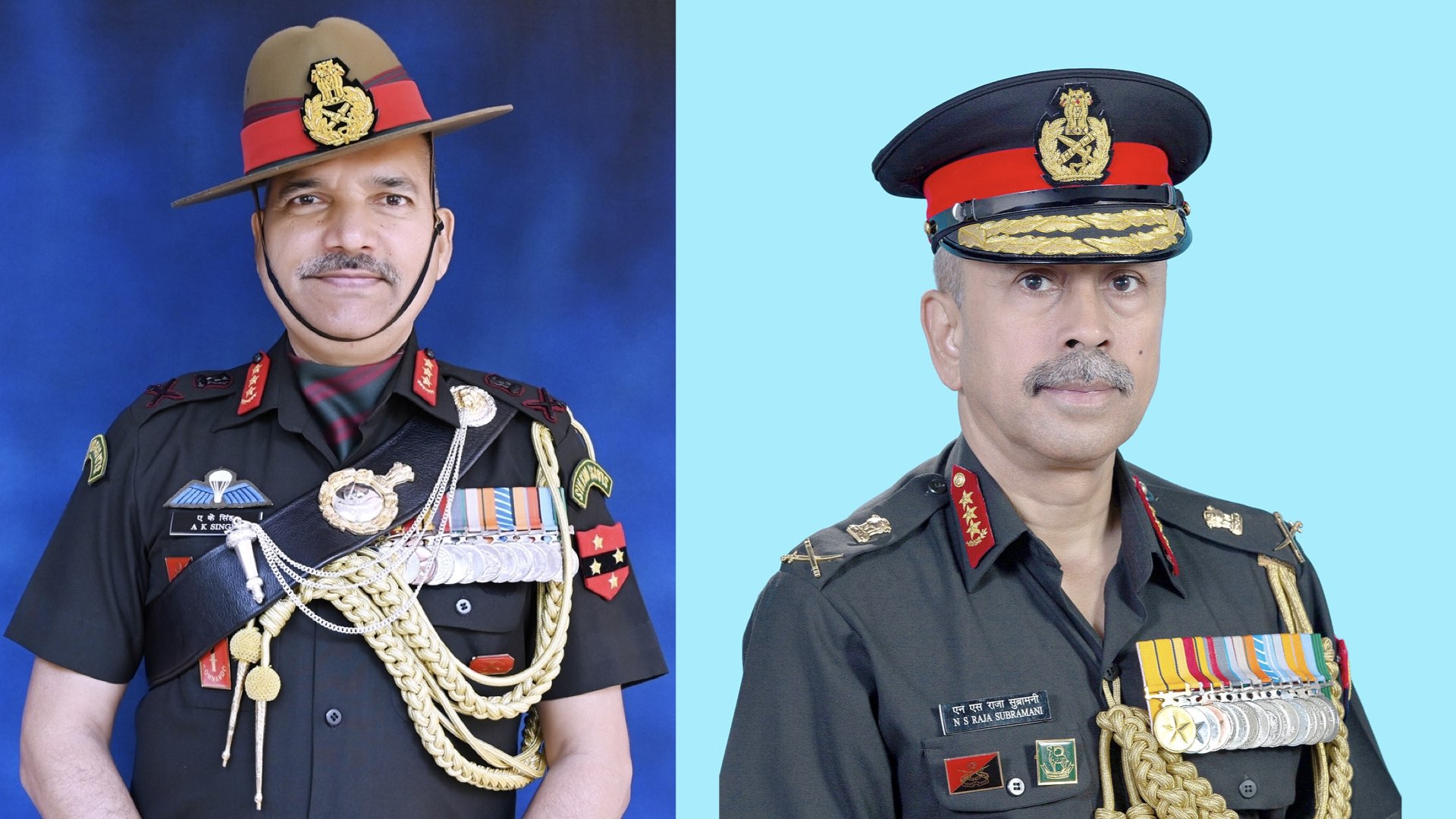
As CDS Anil Chauhan approaches the end of his tenure as India’s Chief of Defence Staff (CDS) in May, the government once again faces a familiar crossroads. The instinct, as seen before, is to turn toward experienced hands senior officers who have already completed service but remain closely linked to the national security establishment.This time, three names are in circulation: Lt Gen A.K. Singh, Lt Gen N. S. Raja Subramani, and Air Marshal P. M. Sinha. All are seasoned officers. All bring institutional memory.
The CDS Role Has Moved Beyond Advisory Comfor
The CDS framework, rooted in lessons from the Kargil War, has evolved rapidly in recent years. What began as a long-pending reform has now entered an execution-heavy phase.
Today, the CDS is expected to actively drive:
- Theatre command restructuring
- Joint logistics and procurement
- Integrated operational planning
- Inter-service prioritisation
This is not a position that can afford a slow start. It requires immediate traction within the system.
The Real Constraint: Authority vs Access
Bringing in a retired officer means re-induction, elevation to a 4-star rank, and then critically re-establishing authority within an already functioning ecosystem of serving chiefs.
That process is not frictionless.
Jointness depends on:
- Continuous engagement
- Peer-level interaction
- Institutional rhythm
An officer returning from outside, regardless of stature, must rebuild this rhythm.
The Supercession Factor: Subtle, But Real
This is where the distinction between the candidates becomes sharper.
While Lieutenant General N.S. Raja Subramani is a highly respected officer, his appointment as CDS would, in effect, amount to supercession within the existing leadership matrix. Even if unintended, such a move introduces a layer of complexity.
Yes, the current chiefs are professionals. They understand institutional decisions and will work within that framework.
But armed forces are not driven by individuals alone, they are shaped by organizational sentiment.
And sentiment does not always align neatly with formal hierarchy.
Perceptions of supercession, even when technically justified, can:
- Create subtle friction
- Affect internal cohesion
- Slow down consensus-driven reforms
In a phase where jointness depends heavily on cooperation, this becomes a non-trivial factor.
Why A.K. Singh Fits the “Partner CDS” Model
This is where A.K. Singh stands out.
Despite being retired, his alignment with the current leadership cohort positions him differently. He is not seen as an external override, but as part of the same generational framework as the current chiefs.
This enables something critical a “Partner CDS” model.
Under this approach, the CDS:
- Operates at parity with the chiefs
- Drives reform through alignment, not assertion
- Maintains continuity in ongoing initiatives
- Avoids the perception of hierarchy disruption
In a system where progress depends on cooperation, this alignment is a force multiplier.
The Strategic Moment
India’s military transformation is at an inflection point. Theatre commands, integrated logistics, and joint structures are no longer theoretical constructs, they are being actively shaped.
At such a moment, the CDS appointment must prioritise:
- Continuity of thought
- Speed of execution
- Institutional harmony
A technically sound decision that ignores internal dynamics risks slowing momentum.
Overall, The choice of the next CDS is not merely about selecting a capable officer. It is about choosing the right fit for the current phase of reform.
Both Lieutenant General A.K. Singh and Lieutenant General N.S. Raja Subramani bring experience. But the system today demands more than experience, it demands alignment without friction.
In that context, the argument for Lieutenant General A.K. Singh is not just theoretical, but in practical sense, It is about ensuring that the CDS functions as intended not as an external authority imposed on the system, but as a partner within it.
And at this stage of India’s military evolution, that distinction could prove decisive.



Leave a Reply